

Market Snapshot (Wednesday, October 7 close)
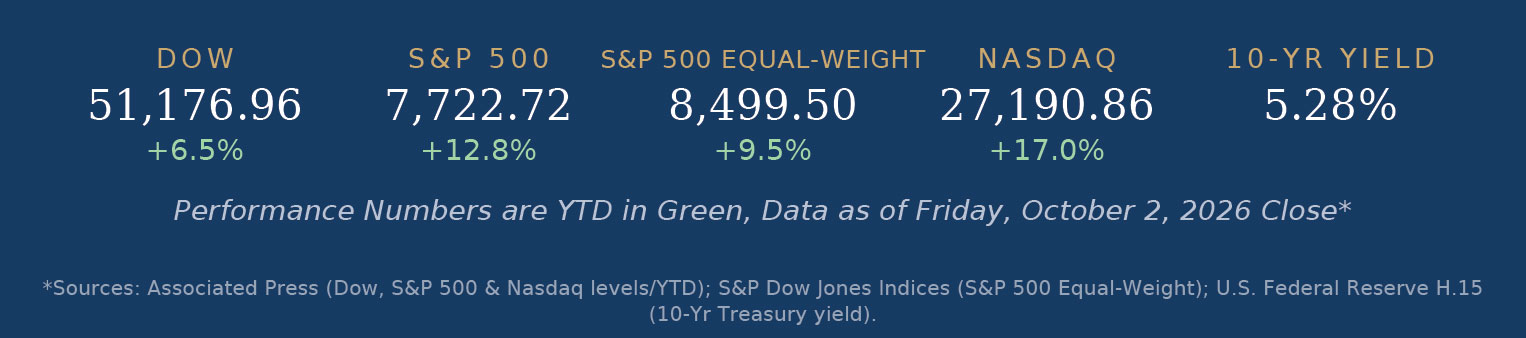
- Dow Jones Industrials: 51,180, down 0.66%
- S&P 500: 7,802, down 0.22%
- Nasdaq: 27,539, down 0.22%
- Russell 2000: 2,793, down 1.31%
- 10-Year Treasury Yield: about 5.3%, highest since 2002
- Oil (WTI): near $90
Currents and Conditions
Markets sent two messages this week. On Tuesday, the S&P 500 closed above 7,800 for the first time, a new record. A day later, the 10-year Treasury yield rose to about 5.3%, its highest level since 2002, after minutes from the Fed’s last meeting showed officials still leaning toward one more rate increase before year-end. Stocks gave back a little ground, with smaller companies feeling it most.
Behind both moves is an economy that is cooling in some places and holding firm in others. Last Friday’s jobs report showed just 29,000 jobs added in September, well short of expectations, with unemployment edging up to 4.2%. In plain terms, hiring has slowed, yet investors still want to own American companies. We read this as a market that respects higher rates but still believes in corporate earning power. So do we.
The Winds of the Week
- A record, then a breather: The S&P 500’s first close above 7,800 came Tuesday, followed by a modest dip Wednesday.
- Cooler hiring: September payrolls rose by 29,000 and unemployment ticked up to 4.2%, making a Fed hike this month look less likely.
- Yields at 24-year highs: A 10-year Treasury near 5.3% is a headwind for some stocks and good news for savers and bond buyers.
- Rotation, not retreat: Utilities and health care rose Wednesday while small companies fell. Money moved around inside the market instead of leaving it.
- Earnings season begins: Third-quarter reports started this week, with the big banks up next.
Perspectives
When stocks sit near records and bonds pay more than they have in two decades, the most useful move is often the least exciting one: rebalancing.
Here is a simple illustration. Say a $1,000,000 portfolio began the year with $600,000 in stocks and $400,000 in bonds. If the stock side grew about 14%, roughly what the S&P 500 has done this year, and the bond side held about even, the mix has quietly drifted from 60/40 to about 63/37. Getting back on target means moving roughly $33,000 from stocks to bonds. At yields around 5%, that $33,000 could generate about $1,650 a year in income.
None of that is a prediction. It is simply trimming what has done well, adding to what now pays well, and keeping your risk where you intended it to be. This example is hypothetical and for illustration only.
Quote of the Week
“You can’t predict. You can prepare.”
-Howard Marks, co-founder, Oaktree Capital Management
Charting the Course
- Monday, October 12: Columbus Day. The bond market and most banks are closed; the stock market is open.
- Wednesday, October 14: September inflation report. The 2027 Social Security cost-of-living adjustment is typically announced the same day.
- Thursday, October 15: Medicare open enrollment begins and runs through December 7. Extended 2025 tax returns are also due.
- October 27 to 28: The Fed’s next meeting.
- Year-end planning: If rebalancing, Roth conversions, tax-loss harvesting, or charitable giving are on your list, let’s get a conversation on the calendar.
Between the Tides of Our Local Community
The Navy’s Blue Angels were formed at NAS Jacksonville in 1946, and next weekend they come home to mark their 80th anniversary. The NAS Jax Air Show runs Saturday and Sunday, October 17 and 18, with free admission and parking, gates at 9 a.m., and the Air Force Thunderbirds sharing the bill. Adults will need a photo ID at the gate.
If you know someone who would enjoy the Weekly Compass, we would be glad to add them to our list.
Warm regards,
Mark Ross & Scott Wohlers
Managing Partners
TradeWinds Wealth Partners
TradeWinds Wealth Partners is a trade name of Elevation Point Wealth Partners, LLC. This newsletter is for informational purposes only and does not constitute investment, tax, or legal advice. Past performance is not indicative of future results. All investing involves risk, including possible loss of principal. Please consult your advisor regarding your individual situation.